Built to Spec: Inside MAX, an AI Assistant That Refuses to Guess
A commercial AI assistant for real inventory, pricing, and order data — deployed in the customer’s cloud, with verified tools and no invented numbers
Iulian Mihai
Principal Cloud Architect & AI Innovation Leader

I spent the last few months building a commercial AI assistant for a construction-materials distributor. What follows isn't really an industry story — it's a blueprint that fits just as well on a hardware chain, a pharmacy counter, or an auto-parts desk.
The problem hiding in plain sight
Picture a sales rep on the phone with a contractor who needs an answer in the next thirty seconds: Do we have this brick in stock? What did this customer pay last time? Can it ship by Friday? The honest version of that call usually involves a hold button, three different screens, and a silent hope that yesterday's export is still accurate.
Every business that runs on an ERP, an inventory system, or a CRM has some version of this moment, dozens of times a day. The data to answer the question almost always exists. What's missing is a fast, trustworthy way to ask it in plain language and get a real answer back — not a guess, not “let me check and call you back.”
That's the problem I set out to solve. I call the result MAX.
What MAX actually does today
MAX shows up wherever the team already is — for this business, that's Telegram, the app the commercial staff already had open all day — plus a web console for managers: dashboards, conversation history, and administration in one place. No new habit to build, no separate app to adopt.
You can type to it or talk to it. Hold a button and speak, and it transcribes and answers like a voice memo. Or open a live conversation and talk the way you'd talk to a person on the phone — including interrupting it mid-sentence, which it handles gracefully instead of talking over you.

The rule that never bends
The AI model is never allowed to touch the database, and it is never allowed to invent a number. It can only ask a small set of verified tools for the current stock level, price, or order history — live, every time.
That rule turned out to be the easy part. The hard part was names. Real customers and products get typed wrong, misheard, and half-remembered — a firm gets called three different things by three different people, none of them the way it's spelled in the system. A database that requires an exact match is useless against that. So MAX searches the way a sharp, patient employee would: try an exact match, then a close spelling, then — the part I'm proudest of — a sound match, so a name typed or spoken wrong still finds the right company because it's heard the way a person would hear it, not just compared letter for letter.
When two answers are genuinely close, MAX doesn't pick one and hope — it asks which one is right. And once a person confirms the answer, it remembers that specific correction, so the next time someone garbles the same name, the right answer already floats to the top. Memory only ever breaks a tie; it never replaces checking the truth.
Interfaces
Chat app the team already uses, plus a web console for managers — dashboards, history, and admin in one place.
Voice I/O
Hold-to-talk transcription, or a live spoken conversation you can interrupt mid-sentence, like talking to a person.
Search engine
Exact match → close spelling → sound-alike match → clarifying question. Never a silent guess.
Learning loop
Confirmed corrections are remembered and resurfaced — a tiebreaker on top of live data, never a replacement for it.
Admin layer
Exportable reports, full user management, and an audit log of every administrative action.
Cost visibility
What the assistant costs to run, in real currency, updated live — not a delayed monthly statement.
Nothing about this is a toy — it's built the way software has to be built when it's allowed to touch real customer and pricing data.
Why this isn't a construction story
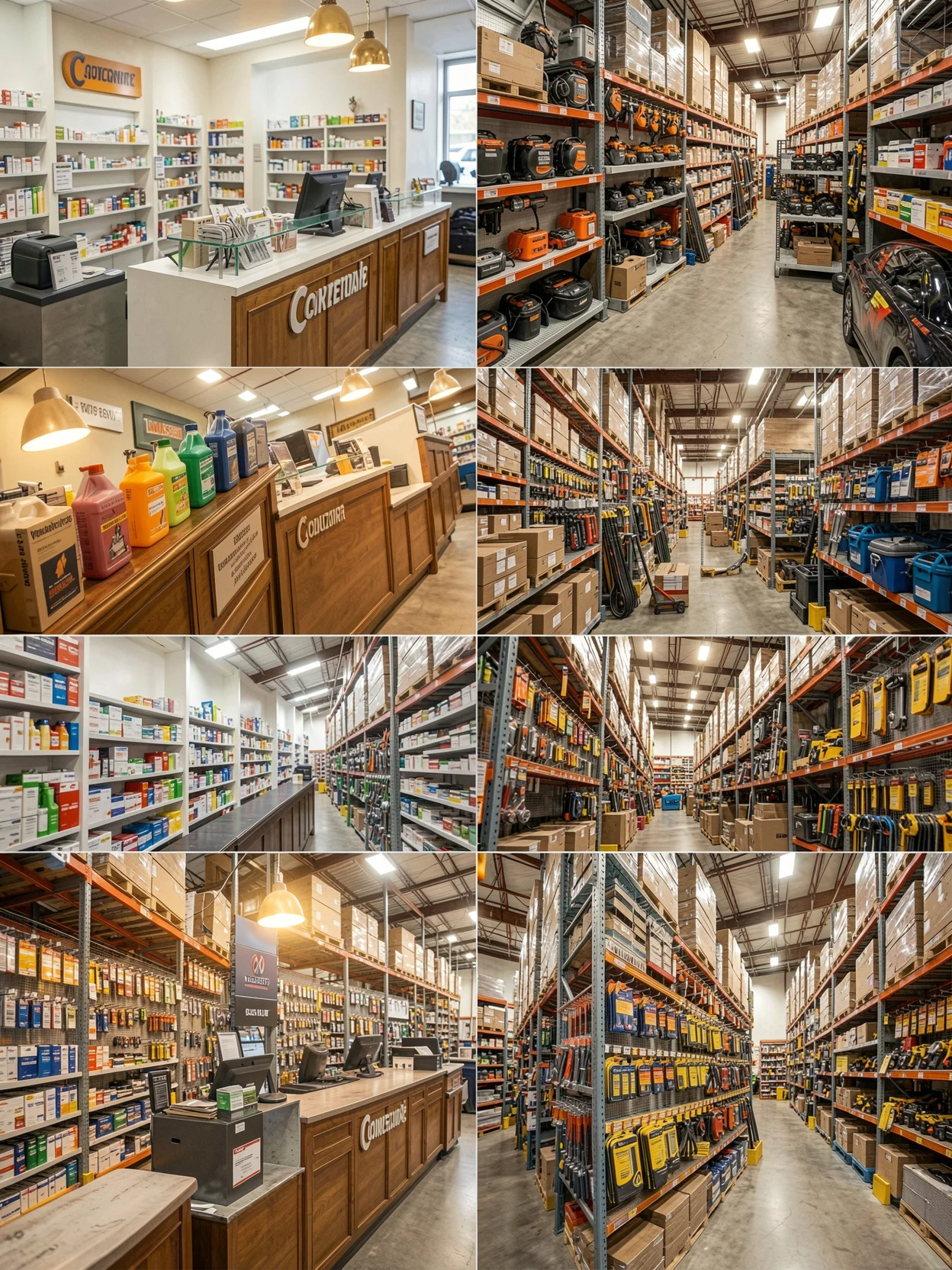
Nothing above is specific to bricks and cement. Swap the inventory: a home-improvement retailer's floor staff fielding “do you have this in stock, and where,” a pharmacy counter checking whether a product is in stock and at what price, an auto-parts desk matching a part number to a customer's car, a wholesale distributor's order desk running the same fifteen questions all day. Any business with a real system of record and people who need fast, correct, natural-language access to it fits the same problem MAX was built to solve. The construction distributor is where it started. It won't be the last kind of business it fits.
Where this is going: the assistant that walks you to the shelf
Here's the version of this I'm most excited to build next.
You walk into a home-improvement store. No one's free to help, and you need two specific products you can't find. Instead of wandering the aisles or paging someone, you pick up a simple handheld device near the entrance — or your own phone — and just ask. MAX doesn't answer with an aisle number. It plots the actual route through the store to exactly where the product sits on the shelf, because the same inventory data that already knows what's in stock can just as easily know where it lives. And along the way, it acts less like a search box and more like a trusted assistant standing next to you: it mentions the fastener you'll need alongside the bracket you asked for, flags that the popular item you wanted is running low and offers the in-stock alternative, tells you the better-priced option sitting one shelf over.
Floor plan · live route from entry to shelf
That's the pitch: not a search engine bolted onto a store, but a knowledgeable assistant who happens to know your entire inventory, your prices, and your floor plan — and who never runs out of patience.
Deployed in your cloud, not mine
This is the part that matters most to any business actually considering this, so I want to be direct about it: MAX runs inside the customer's own cloud infrastructure, not mine. It's installed into the company's own tenant, under their own security controls, their own compliance boundary. Their data never leaves their walls to be pooled on a vendor's shared servers just so a question about their own stock can get answered.
That's a deliberate departure from the usual SaaS pattern — a vendor's server, a per-seat subscription, your operational data living on someone else's infrastructure indefinitely. I'm not renting anyone a seat on my servers. I build the assistant, deploy it onto infrastructure the customer owns, and hand over something they actually control.
If you're comparing this to other enterprise AI patterns — dedicated identities, tool boundaries, tenant isolation — the same principles apply. I've written about them in agentic AI in production and LLM integration patterns. MAX is a concrete instance of those ideas applied to operational data.
What “keeping it alive” looks like
Software that touches real prices, real stock, and real customers doesn't get built once and left alone — it needs the same care any production system does: monitoring, security patching, and steady improvement as the underlying AI models and the business itself change. My engagement with a customer reflects that: an initial project to design, build, and deploy the assistant onto their own infrastructure, followed by an ongoing relationship to keep it healthy, secure, and improving. The cloud costs are the customer's own, visible to them in real time through the same dashboard MAX ships with — never a hidden markup, never a black-box bill.
Why I'm writing this
I built all of this myself, end to end — the AI architecture, the search and language engineering, the backend, the interface, the cloud infrastructure, the security. If your business runs on an ERP, an inventory system, or a CRM, and your staff or your customers are still getting answers the slow way — a hold button, a spreadsheet, a walk down an aisle — this is a solvable problem, and I've already solved most of the hard parts of it once.
Key Takeaways
- The AI never touches the database and never invents a number — it only queries verified tools for live stock, price, and order history.
- Fuzzy name matching — exact, spelling, sound-alike, then clarifying question — handles real-world messiness without silent guesses.
- Deployed in the customer's own cloud — not a shared SaaS seat — with live cost visibility and full data control.
- The pattern generalizes beyond construction — any business with a system of record and staff who need fast, correct answers in plain language.
💡What does your version of “do we have this in stock” look like?
If your business runs on an ERP, inventory system, or CRM — and your team is still getting answers the slow way — I'd like to hear about it.
Tags
Ready to Move AI from Pilot to Production?
I design and secure production AI systems — RAG pipelines, agentic platforms, and LLM integrations — across regulated enterprises. Let's discuss your architecture.
Not sure where to start?